
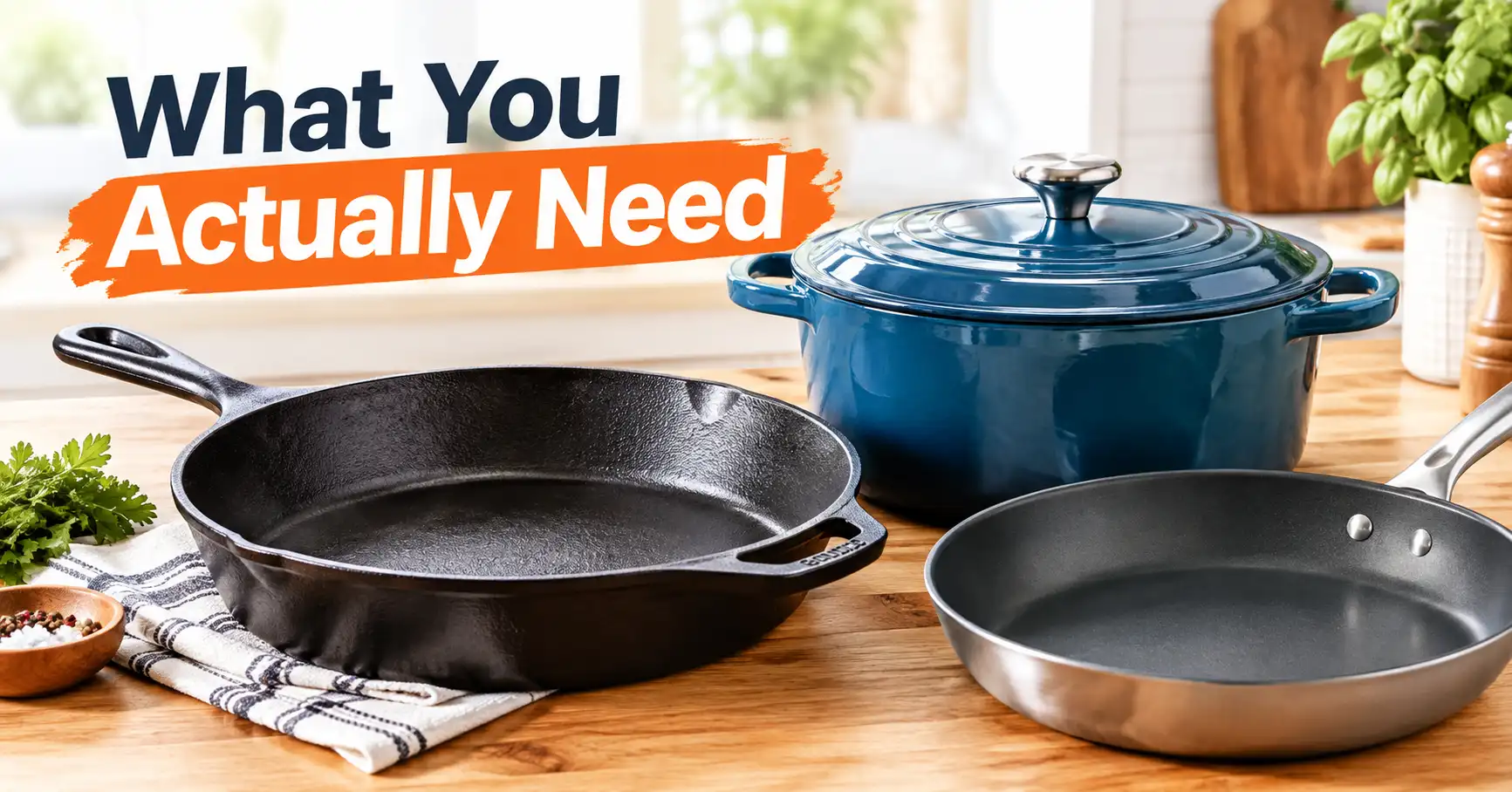
The Home Cook's Guide to Cookware: What You Actually Need
MyChefList is reader-supported. If you buy through links on this page, we may earn a small commission at no extra cost to you. We only recommend products we've researched or tested ourselves.
Table of Contents
There's a specific kind of kitchen chaos that happens around 6:15 on a weeknight: you reach for the pan you need, and it's either warped, sticky in a way that no amount of scrubbing fixes, or buried under three other pans that don't quite do what you need them to do. We've all stood there, spatula in hand, cursing a $12 pan we bought in college.
That moment is usually the one that sends people down a cookware buying guide rabbit hole — forty open tabs, conflicting advice, and a growing suspicion that everyone online is either selling something or has never actually cooked dinner for a family of four.
We're not doing that here. This is the guide we'd send a friend who texted us "hey, what pots and pans should I actually buy?" We've cooked on most of what's below, cross-checked specs and durability claims against what other testers and long-term owners report, and we're going to tell you plainly where a product falls short — because a guide that loves everything equally isn't trustworthy.
By the end, you'll know exactly which pieces earn a spot in a real kitchen, which ones are hype, and what to buy first if you're building a set from nothing.
Short on Time? Our Pick
Our pick: Lodge Cast Iron Skillet, 10.25-inch — it's the single pan that does the most jobs for the least money, and it'll outlast every nonstick pan you'll ever own.
Who This Is For
This guide is for people replacing a mismatched, dying set of pans — the kind that came free with a first apartment or got inherited from a roommate. It's also for beginner cooks building a kitchen from scratch, small-space renters who need pieces that pull double duty, and anyone who's tired of googling "is this pan toxic" at 9 p.m. If you already own $2,000 of All-Clad and are shopping for a specialty paella pan, this probably isn't detailed enough for you — but for almost everyone else, it is.
What Problem It Solves
Most people don't own bad cookware because they don't care. They own bad cookware because nobody ever explained what actually matters. You end up buying based on how a set looks in a box, and six months later the nonstick coating is flaking into your eggs and the stockpot's handle wobbles every time you lift it full of pasta water. The right pieces — even just three or four of them — fix uneven cooking, food sticking, handles that won't hold up, and pans that warp the first time they hit high heat.
What to Look For (Buying Criteria)
Material. Cast iron and stainless steel are the workhorses — heavy, near-indestructible, and they get better with age. Nonstick coatings (ceramic or PTFE-based) make cleanup effortless but have a shorter lifespan, usually three to five years of daily use before performance drops off.
Size. Buy for the meals you actually cook, not the ones you imagine cooking. A 10-inch skillet handles two chicken breasts fine; it can't sear four without steaming them. If you regularly cook for four or more, size up on your main skillet and stockpot.
Price range. Cookware roughly splits into three tiers: budget ($20–$60 per piece, often cast iron or basic stainless), mid-range ($60–$200, where most ceramic nonstick and clad stainless lives), and premium ($200+, enameled cast iron and pro-grade stainless). You don't need to buy every piece from the same tier.
Maintenance. Cast iron needs seasoning and hand-washing. Enameled cast iron and clad stainless can go in the dishwasher, though hand-washing extends their life. Nonstick coatings hate metal utensils and high heat — both shorten their lifespan fast.
Stovetop compatibility. If you have or plan to get an induction range, the pan needs a magnetic base. Cast iron and most stainless steel work automatically; check the label on nonstick and aluminum pieces, because plenty aren't induction-ready.
For the deeper dive on any one category — say you're set on cast iron and want the full comparison — see our Best Cast Iron Skillets for Beginners guide, which goes further into seasoning and brand differences than we can here.
How We Chose These
We started from long-term owner feedback and independent lab testing (cooking evenness, nonstick food release, heat retention, and handle durability), then weighed that against price-to-performance rather than just picking the most expensive option in each category. A few pieces here we've cooked on ourselves for months; for the rest, we cross-referenced repeated patterns across reviews and testing labs rather than trusting a single glowing writeup.
Comparison Table
| Product | Best For | Price Range | Standout Specs |
|---|---|---|---|
| Lodge Cast Iron Skillet, 10.25" | Beginners & budget | $20–$30 | Pre-seasoned, oven-safe to 500°F, lasts decades |
| Made In Enameled Cast Iron Dutch Oven | Splurge / serious braising | $150–$180 | Made in France, tight-sealing lid, broiler-safe |
| Our Place Cast Iron Perfect Pot | Dutch oven alternative | $145–$165 | Lighter than most enameled cast iron, comes with accessories |
| Ceramic Nonstick Fry Pan | Non-toxic nonstick | $75–$95 (single pan) | PTFE- and PFOA-free ceramic coating |
| Calphalon Premier Hard-Anodized Set | Everyday/induction use | $350–$450 (set) | Hard-anodized aluminum, very even heat |
| Cuisinart Chef's Classic Stockpot | Soups & batch cooking | $60–$90 | 12-quart capacity, stainless with aluminum core |
| Tramontina Tri-Ply Clad Saucepan | Small kitchens/sauces | $40–$60 | Tri-ply construction, works on induction |
The Picks
Lodge Cast Iron Skillet, 10.25"
Best Beginner & Budget Pick
At just over five pounds, this pan has real heft the second you pick it up — which is part of why it sears so well. Cast iron holds and radiates heat in a way thin aluminum pans simply can't, so a steak actually browns instead of steaming in its own moisture. It comes pre-seasoned, meaning you can start cooking with it the day it arrives instead of babying it through a seasoning ritual first.
What surprised us is how quickly it goes from stovetop to oven without a second thought — cornbread, a frittata, a whole roasted chicken thigh finish, all fair game, since it's rated to 500°F. The trade-off is the learning curve: acidic foods like tomato sauce can strip the seasoning if you cook them too long, and it needs a hand-dry-and-oil routine after washing, not a toss in the dishwasher.
It's not induction-optimized in the sense of heating evenly edge-to-edge the way a clad stainless pan does, but it does work on induction cooktops.
Pros: Extremely durable, inexpensive, versatile across stovetop and oven, naturally nonstick once seasoned Cons: Heavy, requires hand-washing and occasional re-seasoning, not ideal for acidic sauces
Honest limitation: if you're someone who wants to toss cookware in the dishwasher without thinking about it, this isn't your pan.
Made In Enameled Cast Iron Dutch Oven
Best Splurge
This is the pan you buy once and pass down. The enameled coating means you skip the seasoning maintenance of raw cast iron entirely, while keeping the even, retained heat that makes braising actually work — a pot roast comes out fall-apart tender because the heat holds steady for hours, not because you're babysitting the burner.
The lid seals tightly enough that you can hear the difference when you set it down — a solid, heavy clunk rather than a rattle — which matters more than it sounds like it should, because a loose-fitting lid lets moisture escape during a long braise and dries out exactly what you're trying to keep moist. It's broiler-safe and goes straight from stovetop to oven to table without looking out of place doing it.
The catch is the price and the weight. At over 13 pounds full, it's not something you want to be lifting one-handed out of a low oven rack, and it's a real investment for something you might use twice a month.
Pros: Even heat retention, tight lid seal, stovetop-to-oven-to-table versatility, minimal maintenance Cons: Expensive, heavy, overkill if you don't braise or bake bread regularly
Honest limitation: if your idea of a big cooking project is pasta night, you don't need this — a smaller, cheaper pot does the job.
Our Place Cast Iron Perfect Pot
Best Dutch Oven Alternative
If the Made In price tag above made you wince, this is the answer. It's still enameled cast iron, still naturally nonstick and oven-safe, but it comes in at roughly half the cost of the premium brands and includes a bamboo spatula and silicone gripper — small things, but the gripper genuinely makes lifting a hot lid one-handed less nerve-wracking.
We were impressed watching onions caramelize evenly from the center out to the rim in testing, which is a decent proxy for how a pot handles heat overall. It only comes in one size, 5.5 quarts, so if you regularly cook for a crowd, that's a real constraint rather than a nitpick.
Pros: Significantly cheaper than premium enameled cast iron, comes with useful accessories, good heat distribution Cons: Only one size available, not dishwasher-safe, six color options but no size flexibility
Honest limitation: great for weeknight braises and soups for a family of four; undersized if you cook in bulk or host often.
Ceramic Nonstick Fry Pan
Best Non-Toxic Nonstick
If you've been avoiding nonstick pans over PFAS concerns, this is where that worry gets addressed directly — the ceramic coating skips PTFE and PFOA entirely. Food genuinely releases without a fight; we scrambled eggs with zero oil and got a clean release on the first try, which isn't true of every "ceramic" pan on the market.
It heats up fast thanks to the aluminum core, and the exterior stays cool enough near the handle that you can grab it without a towel most of the time. Where it's honest about its limits: ceramic nonstick coatings degrade faster than PTFE ones, especially with metal utensils or high heat, so expect three to four years of peak performance rather than a decade.
Pros: No PTFE or PFOA, fast and even heating, genuinely nonstick out of the box, attractive enough to leave on the stove Cons: Shorter coating lifespan than traditional nonstick, pricier per pan than basic nonstick options
Honest limitation: don't buy this expecting cast-iron longevity — it's a five-year pan, not a fifty-year one.
Calphalon Premier Hard-Anodized Nonstick Set
Best for Induction & Everyday Cooking
This is the set pick for people who want to stop thinking about pans entirely and just cook. Hard-anodized aluminum heats up quickly and holds a steady simmer — we noticed sauces didn't scorch at the edges the way they do in thinner pans, which matters more than it sounds for anyone making a lot of pan sauces or risottos.
The handles stay cool enough to grab without a mitt most of the time, and everything in the 11-piece set is oven-safe to 450°F. It's compatible with induction, gas, and electric, which makes it a safe buy if you're not sure what cooktop you'll have in five years.
The nonstick durability is the weak point — it's good, not great, and testers noted it wears faster than the set's other performance scores would suggest.
Pros: Excellent, even heating; induction-compatible; comfortable handles; full set covers most cooking needs Cons: Nonstick coating durability is middling for the price; expensive as a full set
Honest limitation: if you cook with metal utensils out of habit, you'll shorten this set's life considerably — budget for a silicone or wood utensil switch alongside it.
Cuisinart Chef's Classic Stainless Stockpot
Best Stockpot
Twelve quarts is the number that matters here — it's big enough for a full batch of stock, a pound of pasta with room to actually boil rather than clump, or a weekend chili that needs to feed a crowd and still have leftovers. The aluminum core sandwiched in stainless steel means it heats faster than a plain stainless pot, so you're not standing around waiting for eight quarts of water to come to a boil.
The handles are riveted rather than welded, which we've found holds up better over years of lifting a full pot. It's dishwasher-safe, though a pot this size rarely fits in most dishwashers anyway, so hand-washing ends up being the practical default.
Pros: Large capacity, heats faster than pure stainless, sturdy riveted handles, dishwasher-safe Cons: Bulky to store, overkill if you rarely cook in batches or for groups
Honest limitation: if your kitchen is genuinely tiny, a 12-quart pot is going to be a storage headache more than a convenience.
Tramontina Tri-Ply Clad Stainless Saucepan
Best All-Purpose Saucepan for Small Kitchens
This is the piece people forget to budget for and then desperately need. A good 3-quart saucepan handles rice, sauces, oatmeal, and reheating soup without dragging out a full-size pot. The tri-ply construction — stainless steel bonded around an aluminum core — means it heats evenly enough that a béchamel doesn't scorch on one side while the other lags behind.
It's induction-compatible and light enough to lift and pour one-handed, which sounds minor until you're straining pasta water at 6 p.m. with a toddler on your hip. It's not going to sear a steak or replace a skillet, and the single size means you're topping it off with a second pot for bigger batches.
Pros: Even heating, induction-compatible, lightweight, genuinely useful daily size Cons: Limited to one capacity, not a substitute for a skillet or stockpot
Honest limitation: buy this as a third or fourth piece, not your first — it's a workhorse, not a centerpiece.
Which Product Is Best for Which Situation
If you're buying your very first "real" pan → Lodge Cast Iron Skillet. If you braise, roast, or bake bread regularly and have the budget → Made In Dutch Oven. If you want a Dutch oven without the premium price → Our Place Perfect Pot. If PFAS-free cooking is a priority → Ceramic Nonstick Fry Pan. If you want one set that covers 90% of weeknight cooking → Calphalon Premier Hard-Anodized Set. If you batch-cook soups, stocks, or pasta for a crowd → Cuisinart Chef's Classic Stockpot. If you're short on storage and need a do-everything saucepan → Tramontina Tri-Ply Saucepan.
Who Should NOT Buy This
If you're outfitting a kitchen for occasional, low-effort cooking — reheating takeout, boiling the occasional egg — you don't need most of what's on this list. A single cheap nonstick skillet and a small pot will genuinely cover it, and spending $300 on a cookware set will just sit half-used in a cabinet. Likewise, if you already own well-maintained cast iron or stainless pieces that still perform, don't replace them out of FOMO — cookware, unlike nonstick coatings, doesn't expire on a schedule. And if your stovetop is induction and you already checked compatibility on your current pans, don't assume you need all-new cookware; a cheap magnet test on the pan bottom tells you in five seconds whether it'll work.
FAQ
Do I need both cast iron and nonstick pans? Most kitchens benefit from having one of each. Cast iron handles high-heat searing and stovetop-to-oven cooking; nonstick handles eggs, delicate fish, and anything you want to clean in thirty seconds. They solve different problems rather than competing.
How long should cookware actually last? Cast iron and stainless steel can last decades, even generations, with basic care. Nonstick coatings — ceramic or PTFE — have a realistic lifespan of three to seven years depending on use and how gently you treat them, regardless of what the marketing implies.
Is more expensive cookware always better? Not linearly. There's a real jump in performance from bargain-bin pans to mid-range cookware, but the gap between a solid mid-range set and a premium one is often about longevity, finish, and brand cachet rather than how your food actually turns out.
Can I mix and match brands instead of buying a matched set? Yes, and it's often smarter. Buying a single great skillet from one brand and a stockpot from another usually beats a matched set where half the pieces are filler you'll never use.
Final Take
If you asked us to outfit a kitchen from zero with four pieces, we'd tell you: a cast iron skillet, a mid-size stainless saucepan, a nonstick pan for eggs, and a Dutch oven if your budget allows it. Everything else is nice to have, not need to have. Buy fewer, better pieces before you buy a matching twelve-piece set — you'll use four of those twelve pieces anyway, so you might as well choose which four.