
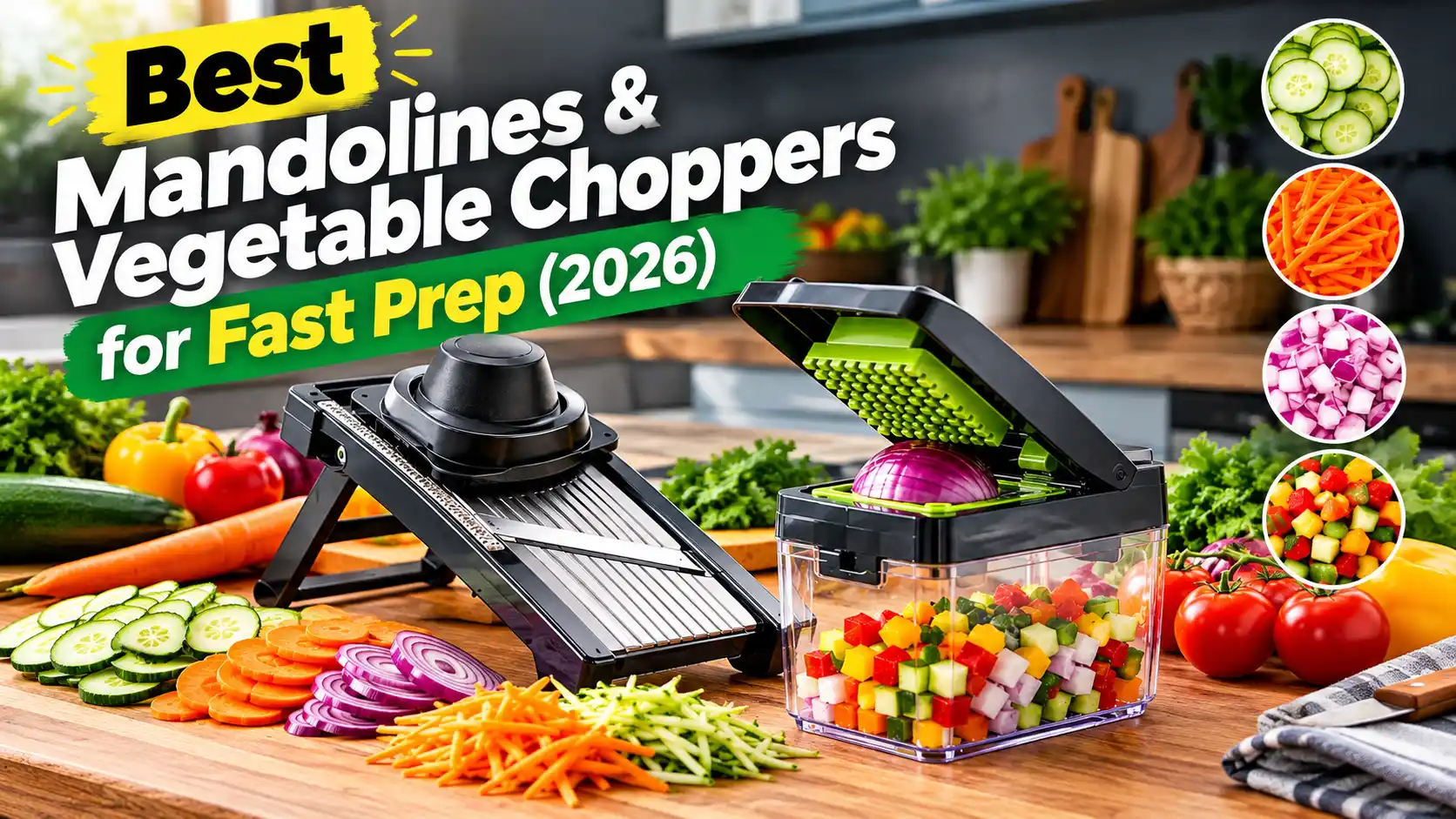
Best Mandolines and Vegetable Choppers for Fast Prep
MyChefList is reader-supported. If you buy through links on this page, we may earn a small commission at no extra cost to you. We only recommend products we've researched or tested ourselves.
There's a specific kind of tired that hits around 6:15 on a weeknight, standing over a cutting board with four pounds of potatoes between you and dinner. We've been there — knuckles aching, slices getting thicker and more uneven the more tired your hand gets, and a gratin that bakes unevenly because half the potatoes are twice as thick as the rest.
That's the problem a good mandoline actually solves. Not "impressing guests with julienned carrots" — just getting through a pile of vegetables in the time it takes the oven to preheat, with slices thin and even enough to actually cook the same.
We've tested a mix of handheld mandolines, standing mandolines, and the all-in-one chopper-style tools that have taken over kitchen counters and TikTok alike, because honestly, a lot of home cooks are better served by a chopper than a classic blade-and-ramp mandoline. This guide covers both, so you can pick based on what you actually cook, not what looks best in a drawer.
For the full rundown of boards to pair with your prep tools, see our cutting board buying guide, and if you're mainly slicing proteins, our best cutting boards for meat pieces are worth a look too.
Short on Time? Our Pick
Short on time? Our pick: OXO Good Grips Chef's Mandoline Slicer 2.0 — the best balance of a genuinely sharp blade, a hand guard that doesn't feel like an afterthought, and thickness settings you can actually read without squinting.
Who This Is For
This guide is for home cooks who prep vegetables often enough that a chef's knife starts to feel like the bottleneck: people making weekly slaws, potato gratins, or big batches of roasted vegetables for the week ahead. It's also for beginner cooks who want uniform cuts without years of knife-skill practice, small-kitchen renters who need something that stores flat in a drawer, and anyone feeding a crowd who doesn't have twenty minutes to hand-slice three pounds of cucumbers for a salad.
If you cook for one and slice a single tomato twice a week, you probably don't need this guide — a sharp knife will do.
What Problem It Solves
A best mandoline slicer earns its keep by solving two things a knife can't: speed and consistency. A mandoline gets you through a five-pound bag of potatoes in the time it'd take to slice one by hand, and it does it at a uniform thickness, which matters more than people expect. Uneven potato slices cook unevenly — the thin ones turn to mush while the thick ones stay raw in the middle. The all-in-one chopper-style tools solve a slightly different problem: they turn dicing an onion from a five-minute, watery-eyed chore into ten seconds and one downward push.
What to Look For
Blade sharpness and material. Stainless steel blades hold an edge longer than the ceramic blades on some budget models, and a genuinely sharp blade actually matters more for safety than people assume — dull blades require more pressure, and more pressure is how fingers slip.
Hand guard design. This is the single most important safety feature on any mandoline. A guard that grips food loosely, or one that only works with larger vegetables, will leave you finishing the last inch of a carrot with your bare fingers. Test it in your hand before you buy if you can, or read reviews specifically about guard fit.
Adjustable thickness. You want a range from paper-thin (for gratins and chips) up to a half-inch or so (for thick-cut fries or fritters). Fixed-thickness models are cheaper but limit what you can actually make.
Footprint and storage. Standing mandolines with fold-out legs are more stable for big jobs but take up real drawer space. Handheld models slide into a flat drawer but require more arm control and, usually, a cutting board or bowl underneath.
Cleanup. Mandolines have narrow gaps where food debris hides, and most manufacturers advise against tossing the blade assembly in the dishwasher even when the body is dishwasher-safe. If you hate hand-washing sharp things, factor that in before you buy.
Price range. Budget handheld mandolines run $15–25, chopper-style all-in-ones land in the $25–40 range, and precision standing mandolines with swappable blades run $40–80, with professional Japanese models topping that.
How We Chose These
We compared spec sheets, published test results from outlets that slice pounds of produce for a living, and patterns across thousands of Amazon and retailer reviews — specifically looking for recurring complaints about hand guards, blade dulling, and thickness-adjustment mechanisms sticking or slipping. We prioritized models with a sustained track record (not just a launch-week rating spike) and cross-checked pricing against current retail listings.
Comparison Table
| Product | Best For | Price Range | Standout Specs |
|---|---|---|---|
| OXO Good Grips Chef's Mandoline Slicer 2.0 | Best Overall | $98–114 | 5 thickness settings, sturdy hand guard, non-slip feet |
| Benriner Mandoline Slicer | Best for Razor-Thin Slices | $15–28 | Adjustable 0.3–3mm blade, Japanese steel, ultra-lightweight |
| DASH Safe Slice Mandoline | Best Budget Handheld | $25–36 | Full-hand safety guard, 3 thickness settings, dishwasher-safe body |
| Mueller Multiblade Mandoline Slicer | Best Multi-Attachment | $30–40 | Straight, wavy, shredder, and julienne blades in one unit |
| Fullstar Pro Core Vegetable Chopper | Best for Dicing & Meal Prep | $20–25 | 6 stainless blades, 1.2L catch container, self-cleaning grid |
| Prepworks by Progressive Adjust-a-Slice | Best Ultra-Budget Pick | $12–18 | Adjustable thickness, compact folding design |
| Joseph Joseph Multi-Grip Mandoline | Best for Small Kitchens | $18–22 | Non-slip multi-grip handle, flat storage, 4 blade settings |
The Picks
Best Overall: OXO Good Grips Chef's Mandoline Slicer 2.0
We keep coming back to this one because it's the rare mandoline that doesn't make you choose between safety and precision. The hand guard has actual heft to it — it locks onto food with a firm click instead of the loose wobble you get on cheaper guards, and the thickness dial has a satisfying, deliberate resistance so it doesn't drift mid-slice the way some spring-loaded dials do.
It's not the fastest mandoline in this lineup. The body is bigger and heavier than a handheld, which is exactly why it's stable — it plants itself on a counter or over a bowl without sliding, even when you're pushing through a dense sweet potato. We ran it through a five-pound bag of russets for a scalloped potato bake, and the slices came out close enough in thickness that they baked evenly without any thin ones going crisp before the thick ones softened.
The trade-off is storage. It doesn't fold flat like a handheld, so if your drawer space is tight, this is the one model in our lineup that might not fit your kitchen at all.
Pros:
- Hand guard actually grips food securely
- Five clearly labeled thickness settings
- Non-slip feet keep it stable during aggressive slicing
Cons:
- Bulkier than handheld options — needs real drawer or shelf space
- Pricier than most picks here
Best for Razor-Thin Slices: Benriner Mandoline Slicer
Professional kitchens have used some version of this Japanese mandoline for decades, and once you use it, it's obvious why. The blade is genuinely the sharpest of anything we tested — it glides through a cucumber with almost no downward pressure, which sounds like a small thing until you realize that's exactly what makes a mandoline dangerous in the wrong hands. Less pressure needed means less chance of your hand lurching forward when the blade suddenly catches.
It's about as minimal as a mandoline gets: a flat plastic body, an adjustable blade, and a basic hand guard. That minimalism is the whole point — nothing to break, nothing to recalibrate, and it's light enough to rinse and air-dry in under a minute. We'd genuinely recommend pairing it with cut-resistant gloves, especially for the last few slices of whatever you're cutting, because the hand guard here is functional but not the most confidence-inspiring in this lineup.
If you want a mandoline you'll actually keep sharp for years rather than replace when the blade dulls, this is worth the extra care it demands.
Pros:
- Sharpest, most consistent slices of any model we compared
- Extremely lightweight and easy to clean
- Trusted by professional kitchens for decades
Cons:
- Hand guard is basic — we recommend cut-resistant gloves for smaller produce
Best Budget Handheld: DASH Safe Slice Mandoline
This is the mandoline we'd hand to someone who's nervous about mandolines in general. The full-hand guard covers your whole palm rather than just fingertips, so even slicing something small and round like a shallot doesn't put your hand anywhere near the blade path. It's not going to give you the paper-thin precision of the Benriner, but for weeknight slaw and quick-pickled onions, it doesn't need to.
Three thickness settings cover the basics — thin, medium, thick — without the fussier multi-position dials some models use. The body is dishwasher-safe, which after a few uses of hand-washing narrower mandolines, is a genuinely appreciated feature.
The one place it falls short is firmer vegetables. A dense sweet potato or a fresh-from-the-garden beet takes more arm strength to push through than the softer produce it handles easily.
Pros:
- Full-hand guard is the most beginner-friendly in our lineup
- Dishwasher-safe body
- Straightforward three-setting thickness dial
Cons:
- Struggles with dense, firm vegetables like raw beets
Best Multi-Attachment: Mueller Multiblade Mandoline Slicer
If you want one tool that replaces a straight slicer, a wavy chip-cutter, a coarse shredder, a fine grater, and julienne blades for each, this is the one that actually delivers on that promise without feeling gimmicky. The V-shaped blade grabbed onto a beefsteak tomato and sliced straight through the stem without tearing — something more than half the mandolines we looked at couldn't manage without pre-cutting the stem off first.
The blade storage box is a small but real convenience: instead of loose blades rattling around a drawer, they click into individually labeled slots. That matters more than it sounds like it should, because losing the julienne blade three weeks in is a common complaint we saw across other multi-blade models.
It's not the most compact option, and switching blades mid-recipe takes a few extra seconds compared to a single-blade mandoline. If you only ever need straight slices, you're paying for attachments you won't use.
Pros:
- Wide range of cuts from one tool: slices, waffle-cuts, shreds, grates, juliennes
- Handles tough-skinned produce like tomatoes well
- Organized blade storage case included
Cons:
- Switching blades adds time compared to single-function mandolines
Best for Dicing & Meal Prep: Fullstar Pro Core Vegetable Chopper
This one isn't a mandoline in the classic sense — it's the chopper-style tool that's genuinely changed how a lot of home cooks handle onions. You set a vegetable on the grid, push down once, and it's diced into a container underneath instead of scattered across your cutting board. For anyone who meal-preps a big batch of mirepoix or diced peppers for the week, this shaves real time off Sunday prep.
The self-cleaning pusher grid is a nice touch — it pushes stuck food forward as you use it, so you're not stopping every third onion to pick bits out of the mesh with a fork. Six stainless blades cover slicing, julienning, and two dicing sizes, and the whole thing packs down into itself for storage, which we appreciated more than expected.
It's genuinely not a substitute for a mandoline when you want long, even slices for something like a gratin — the container size caps how large a vegetable you can process at once, and it's built for dicing, not precision slicing.
Pros:
- Fast, low-effort dicing straight into a storage container
- Self-cleaning grid cuts down on mid-prep cleanup
- Compacts down for drawer storage
Cons:
- Not built for long, thin slices — this is a dicer first
Best Ultra-Budget Pick: Prepworks by Progressive Adjust-a-Slice
At around fifteen dollars, this is the mandoline we'd suggest for someone who wants to try one out before committing to a pricier model. The blade is sharper than the price suggests, and the adjustable thickness dial covers a decent range for the size of the unit.
Where it shows its price is the adjustment mechanism itself — it takes some fiddling to land exactly on the thickness you want, and the hand guard doesn't grip smaller produce like radishes or shallots as confidently as the DASH or OXO models. For big, stable vegetables like potatoes and cucumbers, it's fine. For small, round things, be careful.
It folds flat and stores in a drawer without any fuss, which for the price, is honestly more than we expected.
Pros:
- Very low price for a genuinely sharp blade
- Compact, flat storage
- Handles large vegetables well
Cons:
- Thickness dial can be fiddly to land precisely
- Hand guard underperforms on small, round produce
Best for Small Kitchens: Joseph Joseph Multi-Grip Mandoline
This one earns its spot on storage alone. The multi-grip handle design means it doesn't need a separate stand or base — you hold it directly, and the non-slip grip keeps it steady over a bowl or cutting board. For anyone in a small apartment kitchen without deep drawers, that's the whole appeal: one flat, light piece with no extra parts to lose.
Four thickness settings give you a reasonable range for everyday cooking, and at under twenty dollars with a strong review history, it's one of the better values in this lineup. It won't out-slice the Benriner or match the stability of the OXO on a big batch job, but for slicing a cucumber for a salad or thinly cutting an apple for a tart, it does the job without complaint.
Pros:
- No stand or base needed — stores completely flat
- Comfortable, non-slip multi-grip handle
- Strong value at its price point
Cons:
- Less stable than standing mandolines for large-batch slicing
Which Product Is Best for Which Situation
If you're tight on counter and drawer space → Joseph Joseph Multi-Grip Mandoline. If you want the sharpest, most precise slices and don't mind extra care → Benriner. If you're nervous about mandolines and want the safest learning curve → DASH Safe Slice. If you're outfitting a kitchen for the long haul and want one mandoline to do everything → OXO Good Grips 2.0. If your prep work is mostly dicing onions and peppers for meal prep → Fullstar Pro Core. If you want multiple cut styles from one tool → Mueller Multiblade. If you just want to try a mandoline without spending much → Prepworks Adjust-a-Slice.
Who Should NOT Buy This
If you already own a sharp chef's knife and only slice vegetables occasionally, a mandoline is one more single-purpose tool taking up drawer space you might not use often enough to justify. People with limited hand dexterity or anyone who's had a previous mandoline injury might be better served by a food processor's slicing disc instead — it's slower to clean but keeps your hands entirely away from the blade. And if most of your cooking involves soft produce like ripe tomatoes or avocados, a mandoline is often more trouble than it's worth; a knife handles those better anyway.
FAQ
Are mandolines actually dangerous, or is that overblown? They're one of the more injury-prone tools in a home kitchen, mostly because the blade requires less pressure than a knife and people get overconfident toward the end of whatever they're slicing. Using the hand guard every time, even on the last small piece, is the single biggest factor in avoiding cuts.
Can I put mandoline blades in the dishwasher? Most manufacturers recommend hand-washing the blade assembly even when the body is dishwasher-safe, since the dishwasher can dull the edge over time and the blades can nick other items — or hands — during unloading. Check your specific model's care instructions.
What's the real difference between a mandoline and a vegetable chopper? A mandoline is built primarily for slicing at a consistent thickness; a chopper-style tool like the Fullstar is built for dicing directly into a container. Some models blur the line with multiple attachments, but if precision slicing is your main goal, a dedicated mandoline still outperforms a chopper.
Do I need a standing mandoline or is handheld enough? Handheld is enough for most home cooks slicing a few vegetables at a time. Standing mandolines earn their keep if you're regularly processing large batches — think five pounds of potatoes for a big gratin — where the stability matters more.
Final Take
If you asked us over text which one to get, honestly, it'd depend on what you're already frustrated by. If you've never owned a mandoline, start with the DASH or the Joseph Joseph — cheap enough that it's not a big loss if you don't end up using it, safe enough that you'll actually build confidence with it. If you already know you love using one and want it to last, the OXO is the one that's earned a permanent spot on our counter. Either way, use the hand guard every single time, even on that last inch of cucumber that feels too small to bother with. That's when it gets you.