
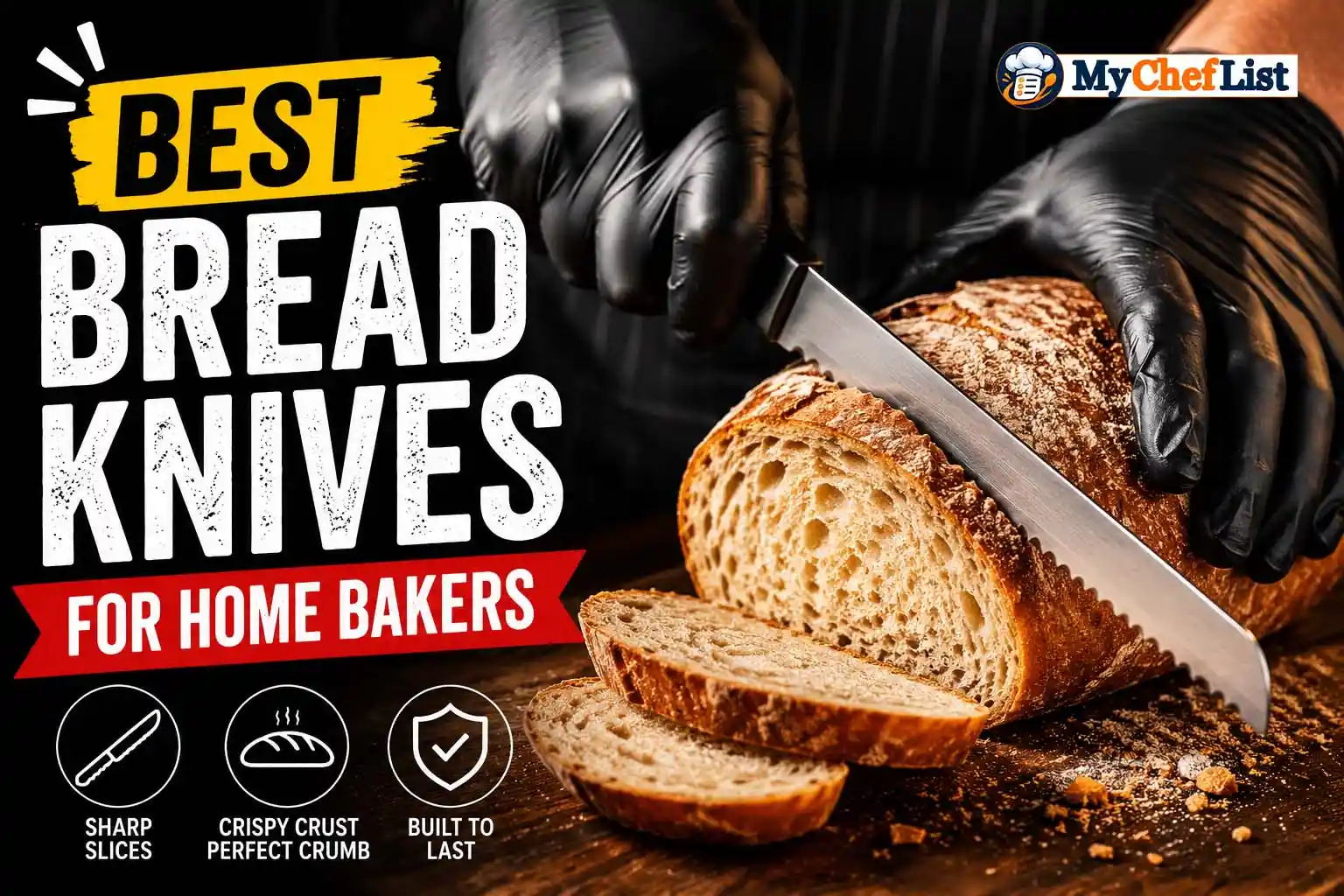
You pull a beautiful sourdough boule from the oven, let it cool, and finally reach for the knife. Then the first slice happens: the crust cracks, the crumb gets squashed, and there's a trail of bread crumbs all over the cutting board.
We've been there. And if you bake regularly, you quickly realize that a good chef's knife isn't a substitute for a proper serrated bread knife.
The best bread knife should bite into a hard crust without requiring you to hack at the loaf, while still being gentle enough to leave the soft interior looking like an actual slice of bread—not a compressed wedge.
MyChefList is reader-supported. If you buy through links on this page, we may earn a small commission at no extra cost to you. We only recommend products we've researched or tested ourselves.
Short on time? Our pick
Our pick: Tojiro 10.6-inch Bread Slicer F-687 — its long, fine serrations make quick work of large sourdough loaves while keeping the cut surprisingly clean.
If you'd rather spend less, the Mercer Culinary Millennia 10-inch is the value pick we'd happily put in a home kitchen. It's inexpensive, uncomplicated, and very good at its one job. Independent testing has also repeatedly highlighted both the Mercer and Tojiro for bread cutting.
Who This Is For
This guide is primarily for:
- Home bakers making sourdough, sandwich bread, baguettes, or enriched loaves.
- People who regularly buy crusty artisan bread.
- Small-kitchen cooks who want one serrated knife that earns its drawer space.
- Anyone tired of crushing soft bread with a straight-edged kitchen knife.
- Home cooks who want a bread knife that can also handle tomatoes, cakes, and delicate pastries.
If you rarely eat or bake bread, you probably don't need an expensive bread knife. A basic serrated model will be enough.
What Problem Does a Serrated Bread Knife Solve?
Bread has an awkward combination of textures. The outside can be hard and brittle while the inside is soft, stretchy, and easily compressed.
A straight blade tends to push against the crust before cutting through it. A serrated blade works differently: the teeth establish small points of contact with the crust, allowing you to use a gentle sawing motion instead of forcing the blade downward.
That's particularly useful with sourdough. You want the crust broken cleanly while leaving the interior open and intact.
For a broader look at where bread knives fit into a kitchen knife collection, see our Types of Kitchen Knives: The Complete Buying Guide.
What to Look For in the Best Bread Knife
1. Blade length
For most home bakers, 9 to 10.5 inches is the sweet spot.
A longer blade makes it easier to cut across a wide boule in fewer strokes. Shorter blades are easier to control but can leave you sawing back and forth across the loaf.
2. Serration pattern
This matters more than the word "premium" printed on the packaging.
Deep, wide serrations tend to bite aggressively into thick crusts. Finer serrations can make cleaner cuts through softer bread and tomatoes.
There's no universally perfect tooth pattern. Your bread matters.
3. Blade flexibility
A little flex can actually be useful. A thin, flexible bread knife can follow the surface of a loaf without requiring much downward pressure.
Too much flex, though, can make the knife feel less controlled. This is one reason some bakers prefer a more substantial forged knife.
4. Handle comfort
Bread cutting involves repeated sawing. If the handle creates a hot spot in your palm after one loaf, you'll notice it.
Look for a handle that feels secure with dry, flour-covered, or slightly damp hands. A grippy synthetic handle isn't glamorous, but in a working kitchen it can be extremely practical.
5. Price
You don't need to spend $150 to get a good bread knife.
The Mercer Culinary Millennia, for example, is typically around the $15–$25 range and has been repeatedly praised for its performance relative to its price. Premium models such as Wüsthof and Shun mainly justify their higher prices through construction, finish, materials, and overall feel—not because inexpensive bread knives suddenly stop cutting bread.
How We Chose These
We looked at current Amazon availability, blade length, serration style, construction, price, and patterns from professional and independent testing. We also paid particular attention to how different knives handle the two things that matter most to bakers: hard crust and soft crumb.
The result is a deliberately mixed list. There are inexpensive workhorses here, a premium splurge, and Japanese options for bakers who prefer a thinner, lighter blade.
Best Bread Knives at a Glance
| Product | Best for | Approx. price | Standout specs |
|---|---|---|---|
| Tojiro F-687 10.6" Bread Slicer | Best overall | $70–$100 | 270mm blade, fine serrations |
| Mercer Culinary Millennia 10" | Best value | $15–$25 | 10" wavy serrated blade |
| Victorinox Fibrox Pro 10.25" | Best workhorse | $40–$75 | 10.25" blade, lightweight Fibrox handle |
| Wüsthof Classic 9" Double-Serrated | Best premium German pick | $130–$160 | Forged construction, double serration |
| Shun Classic 9" | Best splurge | $150–$200 | VG-MAX core, Damascus-style cladding |
| Mercer Genesis 8" | Best forged value | $35–$50 | Forged German stainless steel |
| Tojiro Bread Knife 10.6" | Best thin Japanese option | $35–$80 | Thin, flexible blade |
Amazon prices fluctuate, so treat these as typical ranges rather than fixed prices.
The Picks
Best Overall — Tojiro 10.6-inch Bread Slicer F-687
The Tojiro F-687 is the knife we'd point a serious home baker toward when slicing large loaves is a regular part of the routine.
Its 10.6-inch blade gives you plenty of length for wide boules, and the fine serrations are designed to cut rather than simply tear at the crust. Bon Appétit selected this model as its best bread knife overall after testing dozens of knives, specifically noting the advantage of its long blade for larger loaves.
The interesting thing about the Tojiro is how little force it needs. Instead of leaning heavily into the loaf, you can let the teeth do the work with a controlled back-and-forth motion.
That's exactly what we want from a bread knife.
Pros
- Long 10.6-inch blade works well on large sourdough boules.
- Fine serrations make clean cuts.
- Relatively light for its length.
- Strong choice for frequent home bakers.
Cons
- Longer blade takes some getting used to.
- Less substantial handle feel than a premium German knife.
- Serrated edge is difficult to sharpen traditionally.
Trade-off: If you mostly cut small sandwich loaves, the 10.6-inch blade may feel like more knife than you need.
Best Budget Pick — Mercer Culinary Millennia 10-inch
If someone told us they had $20 to spend and simply wanted a bread knife that works, we'd send them toward the Mercer Millennia.
It's not trying to be a heirloom knife. The stamped blade and molded handle look utilitarian, and that's completely fine. This is the kitchen equivalent of a reliable work shirt.
The wide, wavy serrations are particularly useful on crusty loaves, and professional testing has found that the knife performs impressively for its low price. Bon Appétit even notes that its test-kitchen version had remained in use for years.
It's also inexpensive enough that you don't have to treat it like fine china.
Pros
- Excellent price.
- 10-inch blade suits most loaves.
- Wide serrations grip crust well.
- Comfortable, grippy handle.
Cons
- Stamped construction feels basic.
- Not an heirloom-quality knife.
- Serrations aren't easy to sharpen.
Trade-off: Spend more and you'll get a nicer object in your hand, but you won't necessarily get twice the bread-cutting performance.
Best Workhorse — Victorinox Fibrox Pro 10.25-inch
Victorinox makes the kind of knife that quietly earns its place in busy kitchens.
The Fibrox Pro bread knife is lightweight, long, and fitted with a grippy synthetic handle. That combination makes sense if you're slicing multiple loaves rather than pulling the knife out once every few weeks.
Food Network named this model its best overall bread knife in its 2026 testing, highlighting its smooth, clean cuts and comfortable handling.
The light weight is worth emphasizing. A heavy bread knife can feel impressive on day one. After repeatedly slicing loaves, a lighter knife can be much more pleasant.
Pros
- Lightweight and easy to control.
- Long 10.25-inch blade.
- Grippy Fibrox handle.
- Strong professional-kitchen reputation.
Cons
- Utilitarian appearance.
- Doesn't have the premium feel of forged knives.
- Serrated edge is difficult to resharpen.
Trade-off: If you want something beautiful enough to display on a magnetic rack, this isn't that knife.
Best Premium German Pick — Wüsthof Classic 9-inch Double-Serrated
The Wüsthof Classic is for the baker who wants a bread knife that feels like part of a serious knife collection.
It's forged, full-tang, and built with the substantial feel associated with Wüsthof's Classic line. The double-serrated edge is particularly interesting because the combination of serration patterns is intended to make controlled cuts through both crusty and softer foods.
You can absolutely buy a cheaper knife that cuts bread well. The reason to spend this much is the construction and long-term feel.
Pros
- Forged German construction.
- Full-tang design.
- Excellent balance and handling.
- Premium fit and finish.
Cons
- Expensive compared with Mercer or Victorinox.
- 9-inch blade is shorter than the Tojiro F-687.
- Difficult to justify if you rarely bake.
Trade-off: You're paying for the knife itself as much as the bread-cutting performance.
Best Splurge — Shun Classic 9-inch
The Shun Classic is the bread knife for someone who genuinely enjoys beautiful kitchen tools.
Its VG-MAX core and layered Damascus-style construction give it a distinctly premium appearance, while the 9-inch serrated blade remains practical enough for everyday bread cutting. Food Network included it as its splurge pick and praised its balance, low serrations, and ability to handle everything from bread to tomatoes.
This is not the knife we'd buy simply because we need a bread knife.
It's the knife we'd buy when we want the bread knife to feel special every time we pick it up.
Pros
- Beautiful premium construction.
- Comfortable, balanced handling.
- Excellent cutting performance.
- Strong choice for a high-end kitchen.
Cons
- Expensive.
- Overkill for occasional bread eaters.
- Serrated blades still present sharpening limitations.
Trade-off: The extra money buys refinement and craftsmanship more than dramatically better bread slicing.
Best Forged Value — Mercer Genesis 8-inch
The Mercer Genesis is an interesting middle ground.
It gives you a more substantial forged-knife feel without moving anywhere near the price of a premium Wüsthof or Shun. Its German stainless-steel construction and Santoprene handle make it feel more like a traditional kitchen knife than the lightweight Millennia.
The catch is the 8-inch blade. That's perfectly reasonable for sandwich bread, smaller loaves, and general kitchen use, but large sourdough boules are easier with a 9- or 10-inch blade.
Pros
- Forged construction.
- Comfortable handle.
- More substantial feel than inexpensive stamped knives.
- Reasonable price.
Cons
- Shorter 8-inch blade.
- Not ideal for very wide boules.
- Less aggressive cutting reach than the longer picks.
Trade-off: Choose this for feel and everyday versatility, not for slicing enormous artisan loaves.
Best Thin Japanese Option — Tojiro 10.6-inch
The Tojiro takes a different approach from the heavier German-style bread knives.
Its blade is thin and flexible, which can make it surprisingly easy to move through crusty bread. Bon Appétit's testing found the knife exceptionally sharp and light, with very little resistance through crusty bread.
That thinness is both the attraction and the thing to think about before buying.
If you're comfortable with a lighter, more flexible blade, it's excellent. If you prefer a solid knife with noticeable heft, the Mercer Genesis or Wüsthof will feel more familiar.
Pros
- Thin blade requires little effort.
- Lightweight.
- Sharp serrations.
- Good value for a Japanese-style bread knife.
Cons
- Flexible blade isn't for everyone.
- Less substantial feel.
- Availability and pricing can vary.
Trade-off: Control comes from technique rather than weight.
Which Bread Knife Is Best for Which Situation?
Here's the simple version we'd give a friend:
- You want the best overall → Tojiro F-687.
- You want to spend as little as possible → Mercer Millennia 10".
- You bake frequently and want a reliable workhorse → Victorinox Fibrox Pro.
- You want a premium German knife → Wüsthof Classic.
- You want a beautiful premium Japanese knife → Shun Classic.
- You want forged construction without spending a fortune → Mercer Genesis.
- You prefer a thin, lightweight blade → Tojiro Bread Knife.
- You regularly cut very large sourdough boules → choose a 10"+ model.
Who Should NOT Buy a Serrated Bread Knife?
If you almost never eat bread, don't buy one just because every kitchen knife set seems to include one.
You also don't need an expensive serrated knife if you're only cutting supermarket sandwich bread a few times a month. A basic Mercer or Victorinox will do the job without making your wallet noticeably lighter.
And if your kitchen is extremely small, consider your storage situation first. A 10-inch serrated blade is long. If your knife drawer is already packed, a shorter model may be easier to live with.
For cooks building a knife collection from scratch, we'd rather see the money spent on the knives you use every day first, then add a bread knife when your baking habits actually justify it.
FAQ
Is a serrated knife better for sourdough?
Yes. Sourdough typically has a firm crust and soft interior, which is exactly the combination serrated knives handle well. The teeth bite through the crust without requiring the downward pressure that can crush the crumb.
How long should a bread knife be?
For most home bakers, 9 to 10.5 inches is a practical range. If you regularly bake large boules, a 10-inch or longer blade makes slicing across the loaf easier.
Can you sharpen a serrated bread knife?
Yes, but it's considerably more difficult than sharpening a straight-edged knife because each tooth has its own geometry. Many home cooks simply replace an inexpensive bread knife when the serrations eventually become too dull, while premium knives may be worth sending to a professional sharpening service.
Are expensive bread knives worth it?
Sometimes—but not for everyone. A $150 knife won't make ordinary sandwich bread taste better, so premium models make more sense for frequent bakers who value construction, balance, materials, and long-term ownership.
Final Take
If we were standing in a kitchen with you and you asked which one to buy, we'd first ask how often you bake.
For occasional bread cutting, buy the Mercer Millennia and spend the money you saved on good flour. If you're baking sourdough every weekend, we'd step up to the Tojiro F-687 or Victorinox Fibrox Pro. And if you care as much about the knife itself as the loaf, the Wüsthof Classic or Shun Classic is where the premium money starts making sense.
The important thing isn't owning the most expensive bread knife. It's having a serrated blade that lets you make that first clean cut without crushing the loaf you spent all afternoon baking.
Affiliate Disclosure
MyChefList is reader-supported. If you buy through links on this page, we may earn a small commission at no extra cost to you. We only recommend products we've researched or tested ourselves.
A bread knife solves a problem no straight-edge blade handles well — crusty exteriors and soft interiors need a serrated edge to avoid crushing or tearing. For how this fits alongside the rest of your knife lineup, see our complete guide to kitchen knives.