
By the MyChefList Test Kitchen Team
Table of Contents
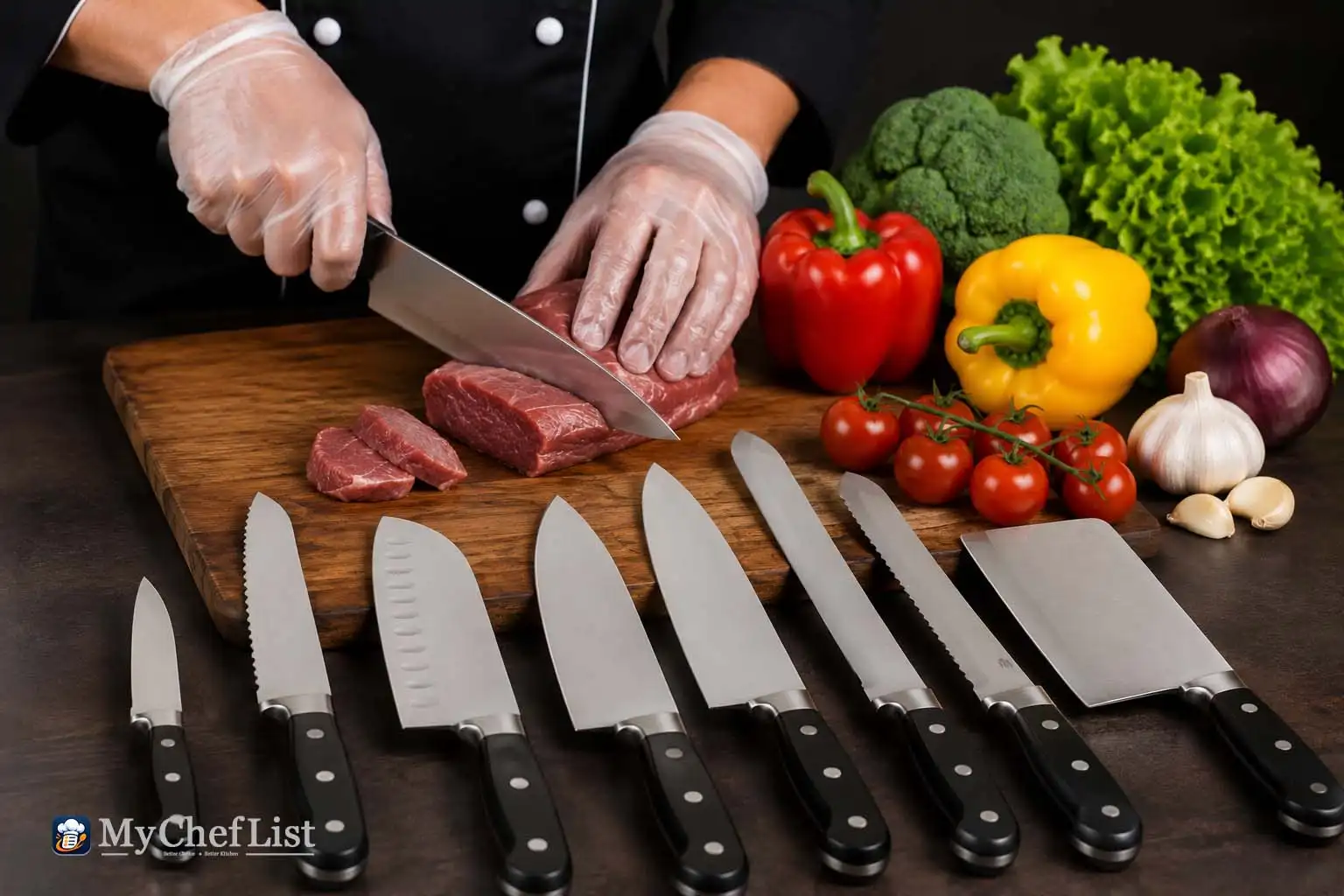
Types of Kitchen Knives Explained
There's a specific kind of frustration that comes from sawing through a tomato with a knife that's more suited to spreading butter. You press down, the skin resists, the whole thing skids sideways, and you end up with mangled slices and a slightly bruised ego. Most people don't have a knife problem so much as a "wrong knife for the job" problem — and the fix usually costs less than you'd think.
We get asked some version of the same question constantly: "What knives do I actually need?" Not what a fancy 15-piece block set includes, but what you'll genuinely reach for on a Tuesday night when you're just trying to get dinner on the table. This guide is our answer — built from years of testing blades in real kitchens, not just reading spec sheets.
Quick Verdict
Short on time? Here's the one knife to buy first: the Victorinox Fibrox Pro 8-Inch Chef's Knife — it does about 80% of what happens on a cutting board, it's light enough for beginners to control, and it costs less than a dinner out. Everything else in this guide is what you add once you know what you're missing.
Who This Guide Is For
This is written for home cooks who are tired of guessing — people building their first real knife collection, upgrading from a mismatched drawer of hand-me-downs, or just trying to figure out why their food prep always feels harder than it should. If you're outfitting a first apartment kitchen, restocking after a move, or buying a gift for someone who cooks, this is your starting point.
It's not written for line cooks assembling a professional roll — if that's you, you already know more than this guide covers.
What Problem This Solves
Most home kitchens have the wrong knives, or too many of the wrong ones. A cheap 15-piece block set often includes three knives you'll use weekly and twelve you'll never touch, while the actual cutting is done with dull, mismatched blades that make every task slower and slightly more dangerous — a dull knife requires more force, and more force is exactly what leads to slips. The goal here isn't to make you buy more. It's to help you own fewer knives that are each genuinely right for their job.
What to Look For When Choosing a Knife
Steel type. Most decent kitchen knives use either stainless steel (easier to maintain, resists rust, slightly less sharp edge retention) or high-carbon steel (holds an edge longer, but needs more care to avoid staining or rust). For home use, stainless is almost always the more forgiving choice.
Full tang vs. partial tang. A full-tang knife has metal running the entire length of the handle, which gives it better balance and durability. Cheaper knives often use a partial tang — fine for light use, but they can feel handle-heavy or flex oddly over time.
Handle material and grip. Pick this up in a store if you can. A knife that feels great in someone else's hand can feel wrong in yours — hand size and grip style genuinely change what "comfortable" means.
Weight and balance. Heavier knives (German-style) plow through denser vegetables with less effort. Lighter knives (Japanese-style) reward precision and control but demand a slightly gentler touch. Neither is objectively better — it's a personal preference thing.
Maintenance you're actually willing to do. A knife that needs hand-washing and regular honing is only a good fit if you'll actually do those things. Be honest with yourself here — the "best" knife on paper is the wrong knife if it ends up sitting dull in a drawer.
Price relative to how often you'll use it. Splurge on the knife you'll use daily. Save on the one you'll use twice a year.
How We Chose These
We started from the knives that consistently show up across professional kitchens and serious home cooks' collections, then narrowed the list based on price-to-performance, how they held up to sustained testing, and how well-suited each was to actual home cooking (not restaurant volume). A few of these we've used ourselves for years; others we cross-checked against extensive owner feedback and specification comparisons where hands-on testing wasn't practical for every option.
At a Glance: Knife Types Compared
| Knife Type | Best For | Price Range | Standout Trait |
|---|---|---|---|
| Chef's Knife | All-purpose chopping, slicing, mincing | $30–$150 | The one knife you'll use daily |
| Paring Knife | Small, precise tasks (peeling, trimming) | $10–$50 | Control over power |
| Bread Knife | Anything with a crust or soft interior | $20–$70 | Serrated edge won't crush |
| Utility Knife | Mid-size tasks between chef's and paring | $15–$60 | The "in-between" workhorse |
| Santoku | Vegetable-heavy prep, thin slicing | $40–$130 | Lighter, precise, less rocking motion |
| Boning Knife | Trimming meat, separating from bone | $20–$80 | Thin, flexible blade |
| Cleaver | Heavy chopping, bone, dense produce | $25–$90 | Weight does the work |
The Picks
Best Overall / Everyday Workhorse
Victorinox Fibrox Pro 8-Inch Chef's Knife
This is the knife we recommend first to almost everyone, and it's not close. It's what a huge number of culinary schools hand new students, not because it's flashy, but because it's genuinely hard to mess up — good steel, a grippy handle that stays secure even when wet, and a price that means you won't panic if you nick it on a bone by accident. We've had one in near-daily rotation for years, and it still takes an edge well.
It won't win any beauty contests sitting in a knife block, and the handle isn't the fanciest material out there. If you want something that photographs well on a countertop, look elsewhere. If you want something that just works, this is it.
- Pros: Excellent value, easy to sharpen, great grip, forgiving for beginners
- Cons: Plain appearance, handle isn't premium material
- Best for: Anyone buying their first serious chef's knife
Best for Precision Work
Wüsthof Classic 3.5-Inch Paring Knife
Paring knives get dismissed as an afterthought, but the difference shows up the moment you're deveining shrimp or hulling a dozen strawberries with a knife that's actually built for small, controlled movements. The Wüsthof's short, rigid blade holds its edge well and doesn't wobble under light pressure, which matters more than it sounds like it would.
It's genuinely not for anything beyond small-scale work — trying to break down a chicken with this would be uncomfortable and slow. That's fine. That's not its job.
- Pros: Excellent control, holds an edge, comfortable for extended precision tasks
- Cons: Useless for anything beyond small/detail work — you need other knives too
- Best for: Fine prep work — peeling, trimming, hulling, deveining
Best for Anything With a Crust
Mercer Culinary Millennia 10-Inch Wide Bread Knife
Try slicing a fresh sourdough loaf with a straight-edge chef's knife and you'll understand instantly why serrated blades exist — you either crush the crumb or saw it into a mess. This one's wide blade and deep serrations glide through crusty bread without compressing the soft interior, and it handles tomatoes just as well, which is honestly an underrated bonus use.
The handle is a bit bulkier than some prefer, and if your hands run small, it might feel slightly awkward at first.
- Pros: Handles crusty bread and delicate tomatoes equally well, budget-friendly
- Cons: Chunkier handle, less nimble for anything else
- Best for: Bread, tomatoes, anything with a firm outside and soft inside
Best "In-Between" Knife
Victorinox Fibrox Pro Utility Knife
There's a real gap between what a chef's knife handles comfortably and what a paring knife can manage, and a utility knife lives right in that gap — slicing a sandwich, trimming smaller cuts of meat, portioning fruit. It's not essential on day one, but once you own one, you'll notice how often you reach for it instead of grabbing the chef's knife for something that didn't need it.
- Pros: Versatile mid-size option, same reliable Fibrox construction as the chef's knife
- Cons: Somewhat redundant if you already own both a chef's and paring knife
- Best for: Mid-size tasks that feel awkward with either extreme
Best for Vegetable-Heavy Cooking
Shun Classic 7-Inch Santoku Knife
If most of what you cook leans vegetable-forward — stir-fries, big salads, lots of dicing — a santoku's flatter blade profile suits that up-and-down chopping motion better than a chef's knife's curved edge, which is built more for a rocking motion. The Shun holds a genuinely impressive edge, and the granton edge (those little divots along the blade) helps prevent thin slices from sticking.
It's an investment piece, and the thinner Japanese-style steel is less forgiving if you're using it on something you shouldn't — frozen food or bone will chip this blade in a way it won't a heavier German knife.
- Pros: Exceptional edge retention, precise control, comfortable for extended prep sessions
- Cons: Pricier, less forgiving of misuse, needs more careful maintenance
- Best for: Cooks who do a lot of vegetable prep and are willing to handle a knife carefully
Best for Breaking Down Meat
Dexter-Russell 6-Inch Boning Knife
Thin, flexible, and narrow — this is built to follow the contour of a bone, not fight against it. If you're breaking down a whole chicken or trimming silverskin off a cut of meat, the flex in the blade genuinely makes the job easier and reduces waste, since you can hug closer to the bone than a rigid blade allows.
It's a specialty tool. If you rarely buy whole cuts or bone-in meat, you likely don't need this yet.
- Pros: Excellent control around bone, reduces meat waste, budget-friendly
- Cons: Single-purpose, not useful for general prep
- Best for: Anyone regularly breaking down poultry or trimming meat at home
Best for Heavy-Duty Chopping
A cleaver's whole design philosophy is "let the weight do the work" — it's not about sharpness alone; it's momentum. Splitting through dense squash, breaking down bone-in cuts, or crushing garlic with the flat side all happen with less effort than you'd expect once you stop trying to use it like a chef's knife.
This is the knife people buy and then rarely use, so be honest about whether your cooking actually calls for it before adding it to the collection.
- Pros: Handles tasks other knives struggle with, durable, satisfying to use
- Cons: Overkill for most everyday cooking, takes up storage space
- Best for: Cooks who regularly break down whole squash, bone-in cuts, or dense produce
Which Knife Is Best for Which Situation
- Just starting out, buying one knife? → Victorinox Fibrox Pro Chef's Knife
- Tight on counter/storage space? → Chef's knife + paring knife covers most needs
- You bake bread or eat a lot of fresh produce? → Add the Mercer bread knife
- Vegetable-forward cooking most nights? → Consider the Shun Santoku as your primary
- You cook whole chickens or bone-in cuts regularly? → Add the boning knife
- Winter squash, melons, dense produce are a regular thing? → The cleaver earns its space
Who Should NOT Buy a Full Knife Set
If you cook simply — mostly sandwiches, quick stir-fries, the occasional pasta night — you honestly don't need seven knives. A chef's knife and a paring knife will cover the overwhelming majority of home cooking, and buying more than that before you know what you're missing usually just means specialty knives sitting unused in a drawer. Start with two, and add only once a specific task keeps giving you trouble.
FAQ
Do I need a knife block, or can I store knives another way? A block isn't necessary — a magnetic strip or an in-drawer knife tray works just as well and often takes up less counter space. What matters more is that blades aren't loose in a drawer knocking against each other, which dulls them faster and is genuinely unsafe to reach into.
How often should I sharpen my knives? Honing (straightening the edge with a honing steel) should happen every few uses. Actual sharpening (removing metal to create a new edge) is usually needed every 6–12 months for a home cook, depending on how often you cook and what surfaces you cut on.
Are expensive knives actually worth it? Only if you'll maintain them properly and use them enough to notice the difference. A well-maintained $40 knife will outperform a neglected $200 one. Spend more once you know your habits, not before.
Can one knife really do almost everything? A good chef's knife genuinely can handle the large majority of home cooking tasks. The other knives in this guide solve specific problems a chef's knife handles less gracefully — they're refinements, not replacements.
Our Final Take
If we were restocking a kitchen from scratch tomorrow, we'd start with just two knives — a solid chef's knife and a paring knife — use them for a month, and only then decide what's actually missing based on what kept feeling awkward. That's a more honest way to build a collection than buying a matching set upfront and hoping it fits how you actually cook.
For specific budget picks, see our guide to the best paring knives under $30, and once you've settled on your main knives, our guide to knife sharpeners will help you keep them performing the way they did on day one.
MyChefList is reader-supported. If you buy through links on this page, we may earn a small commission at no extra cost to you. We only recommend products we've researched or tested ourselves.
If you're ready to put this guide into action, we've broken down our specific picks by need: check out our best chef knives for beginners if you're starting from scratch, our best paring knives under $30 for detail work on a budget, our best knife sets for small kitchens if counter space is tight, our best bread knives guide for anything with a crust, and our best knife sharpeners to keep whatever you buy performing like day one.