
Table of Contents
Best Paring Knives Under $30 Explained
You know the job: you're holding an apple over the sink, trying to peel it cleanly, and your chef's knife suddenly feels ridiculous. It's too long, too heavy, and awkward around your fingers.
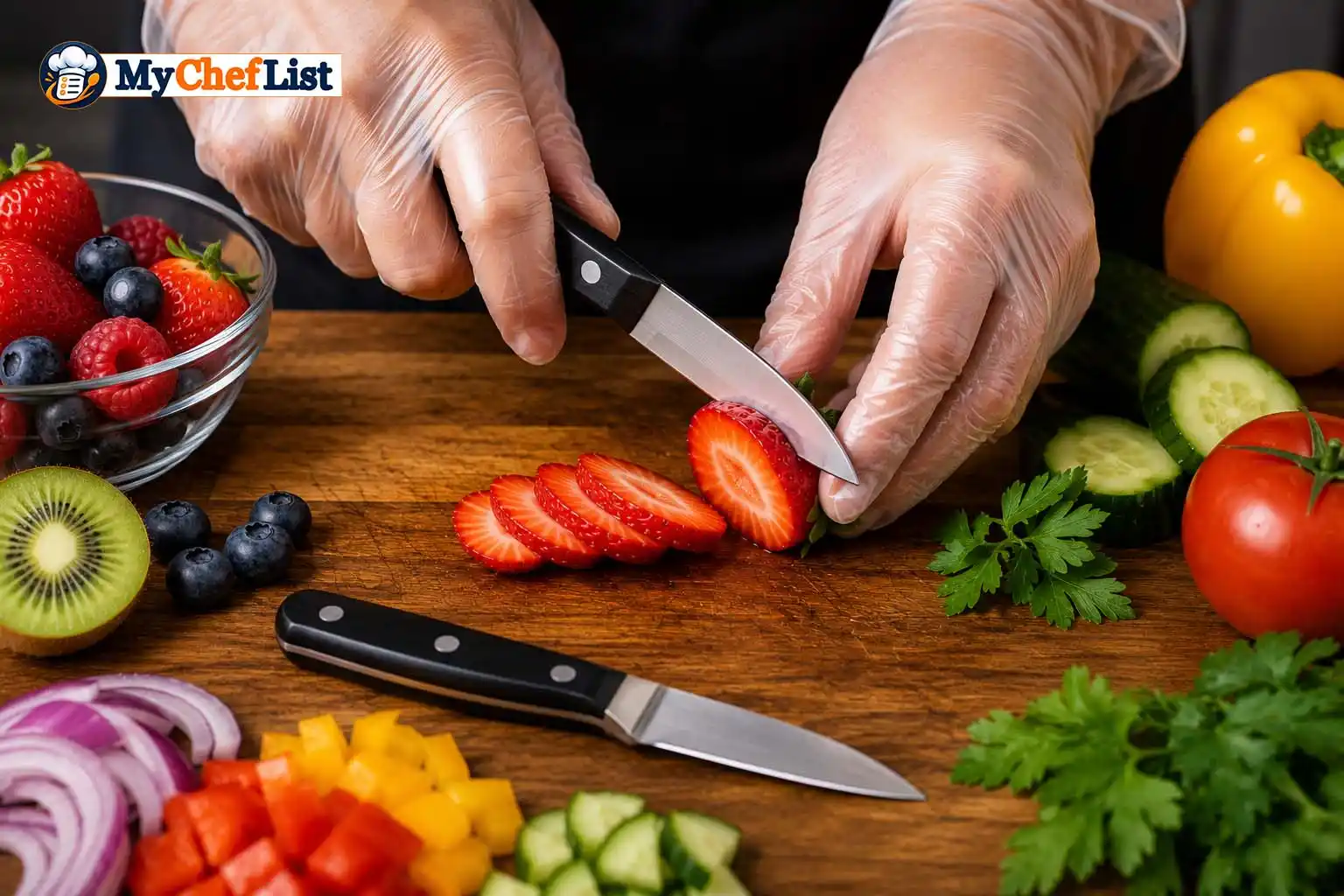
Then there's the strawberry problem. Hulling a dozen strawberries with a blunt little knife can turn a five-minute prep job into a frustrating mess.
A good paring knife doesn't need to cost $50, $80, or $100. We found several genuinely useful options under $30, including inexpensive knives that are comfortable enough to become the one you reach for whenever the cutting gets small and precise.
If you're searching for the best paring knife budget option, our biggest advice is simple: don't confuse an expensive handle or fancy steel with better everyday performance. At this size, control and comfort matter enormously.
Affiliate Disclosure: MyChefList is reader-supported. If you buy through links on this page, we may earn a small commission at no extra cost to you. We only recommend products we've researched or tested ourselves.
Quick Verdict
Short on time? Our pick: Victorinox Swiss Classic 3.25-Inch Paring Knife — it's inexpensive, light, sharp, and exceptionally easy to control for everyday prep.
Food Network's 2026 testing also named the Victorinox 3.25-inch its Best Value paring knife, highlighting its thin, flexible blade, textured grip, and very low price.
Who This Is For
This guide is for home cooks who need a small knife for jobs such as:
- Peeling apples, potatoes, and other produce
- Hulling strawberries
- Coring tomatoes
- Trimming vegetables
- Removing seeds and blemishes
- Cutting small fruits and vegetables
- Deveining shrimp
- Making small, precise cuts by hand
It's also a good fit if you're building your kitchen slowly and don't want to spend heavily on every knife.
If you're still deciding which knives actually deserve a place in your kitchen, see our Types of Kitchen Knives: The Complete Buying Guide for the bigger picture.
What Problem Does a Cheap Paring Knife Solve?
A chef's knife is excellent at chopping a pile of onions. It isn't nearly as pleasant when you're holding a strawberry in one hand and trying to remove its leafy core with the other.
That's where a paring knife earns its drawer space.
The short blade gives you much more control. You can rotate an apple in your hand while peeling, follow the curve around a tomato, or make a tiny cut without having several inches of unnecessary blade in front of your fingers.
The important part is that cheap doesn't have to mean disposable. Some budget paring knives are perfectly capable of handling years of ordinary kitchen work.
What to Look For in a Paring Knives Under $30
1. Blade length
For general-purpose paring, around 3 to 4 inches is the useful range.
A 3.25-inch blade feels nimble for in-hand work, while a 3.5- or 4-inch blade gives you a little more reach for cutting on a board.
If you mostly peel and hull, we'd lean shorter. If you want the knife to double as a small utility blade, go longer.
2. Handle comfort
This matters more than people expect.
A paring knife spends a lot of time in a fingertip-controlled grip. A handle that feels slippery or forces you to squeeze tightly will become annoying quickly.
Textured synthetic handles aren't glamorous, but they're often excellent at this price.
3. Blade thickness and flexibility
A thin blade can be very useful for peeling and following the curves of produce.
The Victorinox, for example, uses a thin and flexible blade that testers found particularly easy to maneuver. The downside is that very thin blades aren't ideal for forcing through dense ingredients.
4. Straight edge vs. serrated
A straight edge is the better all-purpose choice.
Serrated paring knives have a specific advantage with tomatoes, citrus, and soft fruit because the teeth grab the skin rather than sliding across it. But if you're buying only one paring knife, we'd start with straight.
5. Sharpening and maintenance
Don't expect a $10 knife to hold its edge forever.
That's not necessarily a problem. Softer stainless steel is often easy to sharpen, and a quick touch-up is preferable to fighting with a dull blade.
At this price, we'd rather have a knife that's easy to restore than one made from exotic steel that demands specialized maintenance.
How We Chose These
We compared current prices, blade lengths, construction, handle design, and independent testing and reviews, paying particular attention to how the knives perform during actual small-prep tasks rather than simply comparing steel names.
Bon Appétit's testing found the Mercer Genesis particularly impressive for its roughly $25 price, while Food Network's testing gave the Victorinox 3.25-inch paring knife its Best Value designation.
Prices can move, so treat the ranges below as approximate rather than permanent.
Best Paring Knives Under $30 Compared
| Knife | Best for | Approx. price | Standout features |
|---|---|---|---|
| Victorinox Swiss Classic 3.25-Inch | Best overall value | $8–$12 | Thin blade, ergonomic textured handle |
| Mercer Culinary Genesis 3.5-Inch | Best forged budget pick | $20–$25 | Full tang, high-carbon stainless steel |
| Mercer Culinary Millennia 3-Inch | Best cheap workhorse | $10–$20 | Textured Santoprene handle, finger guard |
| OXO Good Grips 3.5-Inch | Best ergonomic handle | $12–$17 | Soft non-slip grip, tapered blade |
| Farberware EdgeKeeper 3.5-Inch | Best for easy storage | $7–$15 | Protective sheath with built-in sharpener |
| Victorinox Fibrox 4-Inch | Best larger budget option | $20–$25 | Non-slip Fibrox handle, 4-inch blade |
| Opinel No. 112 | Best compact traditional option | $15–$20 | Sandvik stainless steel, wood handle |
The Picks
Best Overall Value — Victorinox Swiss Classic 3.25-Inch
This is the knife we'd put in a friend's hand if they said, "I just need a good little knife and don't want to think about it."
The Victorinox is light enough that you barely notice it in your hand. That's useful because paring isn't about swinging the blade through food. You're making small movements, often with the ingredient close to your fingers, and the lighter construction makes those movements feel natural.
The 3.25-inch blade is particularly good for strawberries, apples, citrus, garlic, and small trimming jobs. Food Network's testers found the thin, flexible blade easy to maneuver and specifically praised its ability to handle delicate fruit prep.
The handle isn't luxurious. It doesn't need to be. The textured grip gives you confidence when your hands are wet, which is considerably more useful than a polished decorative handle.
Pros
- Extremely affordable
- Light and easy to control
- Comfortable textured grip
- Good for peeling and hulling
- Easy to replace if eventually lost or damaged
Cons
- Softer steel doesn't hold an edge as long as premium blades
- Thin blade isn't ideal for dense vegetables
- Basic appearance
The trade-off: It prioritizes practicality over refinement. If you want a substantial, beautifully finished knife, look elsewhere.
Best Forged Budget Pick — Mercer Culinary Genesis 3.5-Inch
The Genesis is the interesting choice if you look at the Victorinox and think, "I'd actually prefer something with a little more substance."
It's forged and full tang, which gives it a more substantial feel than the lightweight stamped knives in this price range. Bon Appétit's testers were impressed by how sharp it was out of the box and found it capable of coring and slicing strawberries, cutting hard cheese, and peeling apples with little effort.
There's a noticeable difference when you hold it. It doesn't feel like a disposable little blade.
The point is also useful for jobs such as hulling strawberries and detailed peeling. The larger handle won't suit every hand, though, and some testers found it less maneuverable for certain tasks.
Pros
- Forged construction
- Full-tang design
- Sharp out of the box
- Comfortable for many users
- Excellent performance for around $20–$25
Cons
- Heavier than Victorinox
- Larger handle can feel awkward for smaller hands
- Not as nimble for delicate in-hand work
The trade-off: You get a more substantial knife, but that extra heft isn't necessarily an advantage for every paring task.
Best Cheap Workhorse — Mercer Culinary Millennia 3-Inch
The Millennia is the practical, no-nonsense option.
Its handle has a textured Santoprene-style grip and a molded finger guard, giving it the sort of utilitarian appearance you'd expect to see in a culinary school or busy restaurant kitchen.
That's not a criticism.
This is the knife you buy because you need something inexpensive that works. The 3-inch blade keeps it compact, and the handle is designed to stay secure during repetitive prep.
It's also available in different colors, which can be handy if you use several small knives in a busy kitchen.
Pros
- Very affordable
- Compact 3-inch blade
- Grippy handle
- Finger guard
- Good choice for everyday prep
Cons
- Institutional-looking design
- Finger guard may interfere with some grips
- Edge retention is not exceptional
The trade-off: The protective handle design is helpful for some cooks but can feel restrictive if you prefer placing your fingers close to the blade.
Best Ergonomic Handle — OXO Good Grips 3.5-Inch
OXO understands handles.
The Good Grips paring knife uses a soft, non-slip handle that feels noticeably different from the hard plastic found on many inexpensive knives. If you have trouble finding small knives that feel comfortable in your hand, this is one we'd try.
The 3.5-inch tapered stainless-steel blade is long enough for basic board work while remaining compact for peeling and trimming.
OXO also offers versions with a locking sheath, which is useful if you don't have a dedicated knife block or drawer organizer. Current listings put the standard model around $15.
Pros
- Comfortable soft-grip handle
- Secure feel
- Useful 3.5-inch blade
- Affordable
- Good everyday versatility
Cons
- Handle is bulkier than some traditional designs
- Not especially refined
- Hand washing is recommended
The trade-off: The excellent grip comes with a slightly chunkier handle, which won't appeal to everyone.
Best for Easy Storage — Farberware EdgeKeeper 3.5-Inch
The Farberware EdgeKeeper has one feature that makes it stand out from the other budget knives: the protective cover incorporates a built-in sharpener.
That's convenient if your kitchen doesn't have much knife-storage space.
You slide the knife into its sheath, and the design is intended to help maintain the edge each time you store it. Current retail listings show the knife selling for well below $20.
We wouldn't choose it specifically because we believe a built-in sharpener is superior to proper sharpening. We wouldn't. But for someone who wants a cheap knife with protected storage and minimal fuss, the package makes sense.
Pros
- Very inexpensive
- Protective sheath
- Built-in sharpening feature
- 3.5-inch blade
- Convenient for drawers and small kitchens
Cons
- Built-in sharpener isn't a replacement for proper sharpening
- Less refined cutting feel
- Hand washing is recommended
The trade-off: Convenience is the selling point, not premium blade performance.
Best Larger Budget Option — Victorinox Fibrox 4-Inch
The Victorinox Fibrox 4-inch paring knife is the choice for cooks who find traditional 3-inch paring knives just a little too short.
Its 3.9-inch blade gives you more room for slicing, trimming, and small board work, while the Fibrox handle provides the secure, non-slip grip Victorinox is known for. Victorinox lists the knife at $25 before tax on its U.S. site.
The extra length makes this knife feel closer to a small utility knife than a classic tiny parer.
That can be exactly what you want.
Pros
- Larger 4-inch blade
- Excellent grip
- Swiss made
- Lightweight
- Dishwasher-safe according to Victorinox
Cons
- Longer blade is less nimble for some in-hand peeling
- More expensive than the basic Swiss Classic
- Still a stamped budget knife
The trade-off: You gain versatility but lose a little of the fingertip control that makes very short paring knives so useful.
Best Traditional Compact Option — Opinel No. 112
If you don't like the look and feel of modern plastic-handled knives, the Opinel No. 112 is a refreshing alternative.
Its compact format and traditional wood handle give it a completely different personality from the Victorinox and Mercer models. Steel Snob lists the Opinel No. 113 among its budget recommendations, highlighting its Sandvik 12C27 stainless steel and wood handle.
This isn't the knife we'd choose for someone who wants a purely utilitarian restaurant-style tool.
It's more appealing if you enjoy the tactile feel of wood and want a small knife that looks at home in a drawer or picnic basket as well as the kitchen.
Pros
- Traditional wood handle
- Compact
- Stainless steel blade
- Comfortable for peeling and fruit prep
- Distinctive feel
Cons
- Wood requires more care
- Less grippy when wet than synthetic handles
- Not as universally versatile as the Victorinox
The trade-off: It has more character, but less fuss-free practicality.
Which Paring Knife Is Best for Which Situation?
If you want the best value → Victorinox Swiss Classic 3.25-Inch.
If you want a forged knife under $30 → Mercer Culinary Genesis 3.5-Inch.
If you want the cheapest practical workhorse → Mercer Culinary Millennia.
If handle comfort is your priority → OXO Good Grips 3.5-Inch.
If you want protected storage → Farberware EdgeKeeper.
If you want a longer blade → Victorinox Fibrox 4-Inch.
If you prefer a traditional wood handle → Opinel No. 112.
For most people, we'd still buy the Victorinox. At this price, it's difficult to justify spending twice as much simply for a prettier handle.
Who Should NOT Buy a Budget Paring Knife?
If you use a paring knife heavily every day and care deeply about edge retention and blade geometry, you may eventually outgrow these inexpensive options.
You also shouldn't expect a $10 knife to perform like a $100 forged Japanese blade. It won't.
And if you already own a good 3.5- or 4-inch utility knife that handles your small prep jobs comfortably, buying another paring knife may simply create drawer clutter.
One final point: don't use a paring knife for jobs it wasn't designed to do. Frozen food, bones, hard squash, and twisting cuts can damage a small blade quickly.
FAQ
What is the best paring knife budget option?
For most home cooks, we'd choose the Victorinox Swiss Classic 3.25-inch. It's inexpensive, comfortable, easy to control, and well suited to the small precision jobs paring knives are designed for. Food Network also selected it as its Best Value paring knife in its 2026 testing.
Is a $10 paring knife worth buying?
Yes. A good inexpensive paring knife can handle peeling, trimming, hulling, coring, and other small kitchen jobs extremely well. The Victorinox Swiss Classic is a good example of a budget knife that performs far above what its price suggests.
Is a 3-inch or 4-inch paring knife better?
A 3- to 3.5-inch blade is generally better for precise in-hand work because it's easier to control. A 4-inch knife gives you more reach and can double as a small utility knife, so the better size depends on how you work.
Can I put a budget paring knife in the dishwasher?
Some manufacturers, including Victorinox for its Fibrox 4-inch model, list their knives as dishwasher safe. Still, hand washing and drying is the safer habit if you want the blade and handle to last as long as possible.
Final Take
If you asked us to spend less than $30 on one paring knife, we'd buy the Victorinox Swiss Classic and put the remaining money toward something else in the kitchen.
There's no shame in buying a $10 knife. In this category, cheap can actually be smart.
A paring knife does small jobs. You don't need to turn it into a luxury purchase just because the rest of your knife collection is getting nicer.
Related Reading
If you're building your knife collection from scratch, start with our Types of Kitchen Knives: The Complete Buying Guide to see which blades are actually worth owning.
A paring knife isn't meant to replace your chef's knife — it's built for the small, precise jobs a bigger blade handles awkwardly. If you're still deciding on your primary knife, our best chef knives for beginners roundup is the place to start, and our complete kitchen knife guide explains exactly where a paring knife fits into a well-rounded collection.