
Table of Contents
Best Knife Sharpeners for Home
There's a specific kind of frustration that comes from trying to slice a ripe tomato with a knife that just... pushes it around instead of cutting it. You end up sawing, the tomato collapses into mush, and you're standing there wondering if the knife is broken. It isn't. It's just dull.
Most of us don't think about knife sharpness until a moment like that. We bought a decent chef's knife, used it a few hundred times, and never once ran it across anything but a cutting board. Meanwhile, the edge has been quietly rolling over and losing its bite the whole time.
The fix isn't a new knife. It's a best knife sharpener for home use that actually restores an edge instead of just polishing a dull one. That's the distinction that trips people up — a honing rod straightens a bent edge, but it doesn't remove metal or create a new one. A real sharpener does.
We put together this guide after comparing the sharpeners home cooks actually reach for again and again — the ones that show up in professional kitchens, on gearheads' counters, and in the "what do you actually use" answers from chefs we've talked to.
Quick Verdict
Short on time? Our pick: Chef'sChoice Trizor 15XV — it's the closest thing to a "drop the knife in, pull it through, get a shaving-sharp edge" experience without any guesswork.
Who This Guide Is For
This is written for home cooks who want their knives to actually cut, not just look sharp. That covers a lot of ground: apartment renters who don't have room for a full sharpening station, parents who cook every night and can't afford a dull knife slipping mid-chop, weekend bread bakers who need a serrated edge that still bites, and the person who inherited a good knife from a relative and has no idea it's been dull for two years. If you own at least one knife you actually cook with regularly, this is for you.
What Problem It Solves
A dull knife doesn't just make cooking slower — it makes it more dangerous. You end up pressing harder to force the blade through food, and that extra pressure is exactly what causes a knife to slip and skid across a carrot instead of through it. A sharpener restores the actual cutting edge (the microscopic teeth along the blade) that dulls from repeated use, cutting boards, and contact with hard surfaces like bones or frozen food. Regular maintenance — most manufacturers recommend sharpening one to two times a year for average home use, more if you cook daily — keeps that edge doing its job.
What to Look For
Sharpening angle. German-style knives (Wüsthof, Henckels) are typically sharpened to around 20 degrees per side, while Japanese and Asian-style knives are sharpened to around 15 degrees for a thinner, more precise edge. Using the wrong angle system can actually damage a knife you paid good money for, so check what your knives are built for before buying — we cover this in more depth in our complete guide to kitchen knife types.
Manual vs. electric. Electric sharpeners are faster and more forgiving of inconsistent technique, but they remove more metal per pass and shorten a blade's lifespan slightly faster than a whetstone would. Manual pull-through sharpeners split the difference. Whetstones give you the most control and the longest knife life, at the cost of a real learning curve.
Grit range. Coarser grits (around 100–400) reshape a badly damaged or very dull edge. Finer grits (1000 and up) refine and polish that edge. A sharpener or stone with at least two grit stages will take you further than a single-stage tool.
Compatibility with serrated blades. Not every sharpener handles bread knives or serrated steak knives. If you've got serrated blades in the block, check for that specifically — it's an easy detail to miss.
Price and maintenance. Pull-through and electric sharpeners are largely maintenance-free. Whetstones need to be soaked or flattened periodically and stored somewhere they won't crack. Factor that ongoing effort into the price, not just the sticker on the box.
How We Chose These
We compared spec sheets, sharpening-angle systems, and grit stages across the sharpeners that consistently turn up as recommendations from culinary sources and professional test kitchens, then cross-referenced hands-on owner feedback for durability and ease of use over time. We prioritized tools with a track record of at least a few years on the market — sharpeners are one category where "brand new and untested" is a real risk.
Comparison Table
| Sharpener | Best For | Price Range | Standout Specs |
|---|---|---|---|
| Chef'sChoice Trizor 15XV | Overall / Electric | $140–$160 | 3-stage, 100% diamond abrasives, 15° edge |
| Work Sharp Precision Adjust | Manual Precision | $60–$70 | Adjustable angle guide, replaceable abrasive belts |
| Presto EverSharp | Budget Electric | $49–$65 | 2-stage, spring-guided slots |
| King KDS Combination Whetstone | Serious/Japanese Knives | $35–$45 | 1000/6000 dual grit |
| Global MinoSharp 3 | Japanese-Style Knives | $45–$55 | Water-cooled ceramic wheels, 2-stage |
| AccuSharp 2-Step | Budget Pick | $15–$20 | Tungsten carbide + ceramic stages |
| KitchenIQ Edge Grip 2-Stage | Small Kitchens/Renters | $12–$18 | Compact, one-hand grip |
The Picks
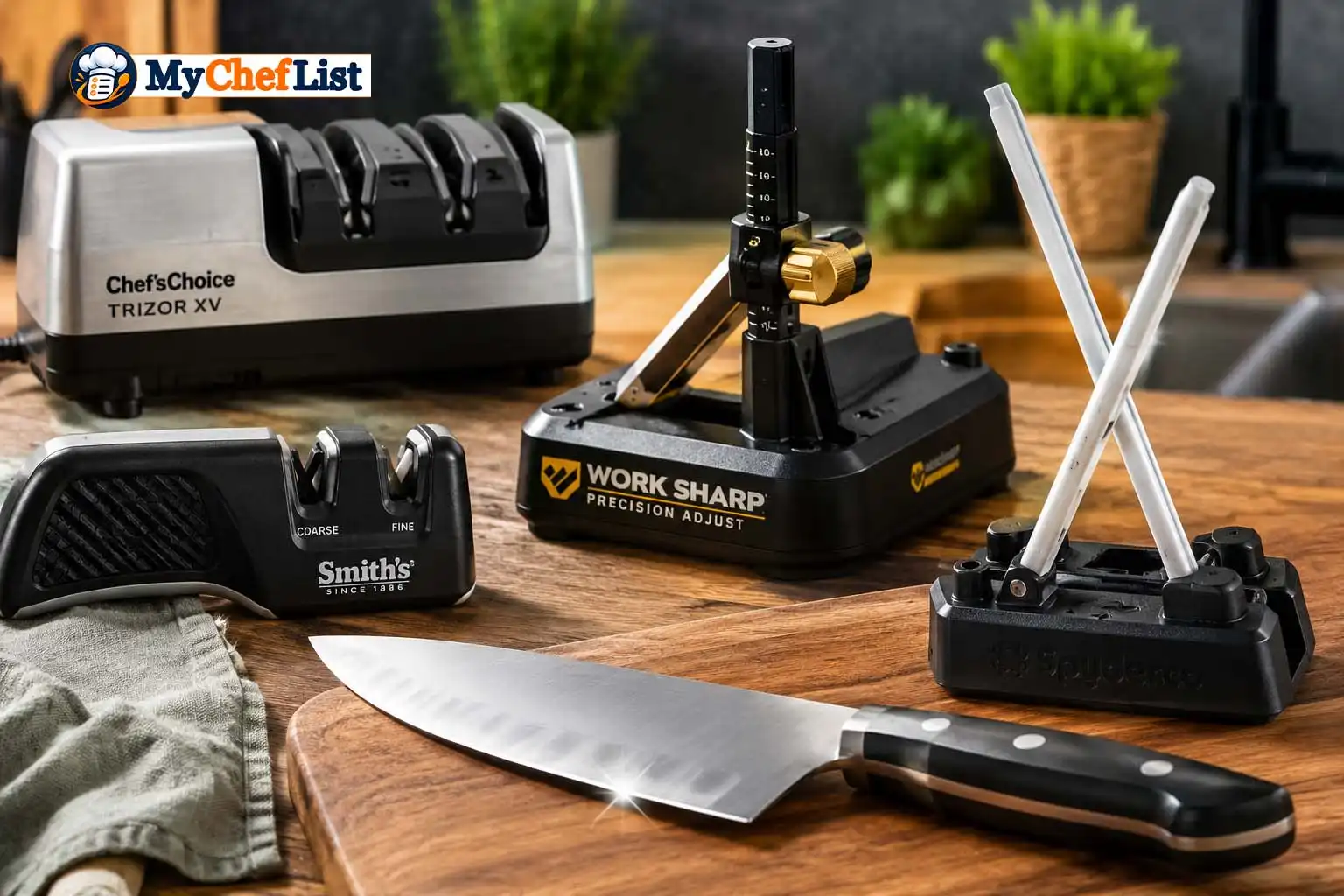
Best Overall: Chef'sChoice Trizor 15XV
We keep coming back to this one because it removes the two biggest failure points in home sharpening — inconsistent angle and inconsistent pressure. You pull the blade through each of the three slots, and the machine handles the rest. It's genuinely loud, which surprises first-time buyers, and it runs for a few seconds per pass rather than being instant.
It's built around a 15-degree edge, which suits Western and hybrid knives well but is a slightly aggressive match for very thin Japanese blades — check your knife's factory angle before committing. The diamond abrasive wheels also remove noticeably more metal than a whetstone would, so a knife sharpened on this every few months will need replacing sooner than one maintained by hand.
Pros: Consistent results with zero technique required; handles straight and serrated edges; fast.
Cons: Loud; removes more metal per use than manual options; not ideal for thin Japanese-style blades
The honest trade-off: this is a machine doing a craftsman's job for you, and it shows in the edge — it's sharp, but not the mirror-polished edge a patient whetstone user can achieve.
Best Manual: Work Sharp Precision Adjust
This one sits in the sweet spot between a whetstone and an electric sharpener. A clamp holds the blade at a fixed, adjustable angle while you draw abrasive belts across it by hand — so you get whetstone-level control without needing years of freehand practice to hold a steady angle.
The belts wear out and need replacing eventually, which is a recurring cost worth budgeting for if you use it often. First-time setup takes a few extra minutes to get the clamp angle dialed in correctly, and it's not something you'll want to do while multitasking.
Pros: Adjustable angle for different knife styles; replaceable abrasive belts; real control over the finished edge. Cons: Steeper learning curve than a pull-through; replacement belts are an ongoing cost
The honest trade-off: it takes longer than an electric sharpener and asks more of you — but the edge quality reflects that extra effort.
Best Budget Electric: Presto EverSharp
This is the sharpener we'd point a first-time buyer toward if the Trizor's price tag is a stretch. It's a simple two-stage electric with spring-guided slots that hold the blade at a preset angle, so there's very little to get wrong.
It won't produce the same edge refinement as the Trizor, and the housing feels noticeably more plastic in the hand. For someone maintaining a few everyday knives rather than a full collection of premium blades, that's a fair trade for the price.
Pros: Affordable entry point into electric sharpening; simple two-stage design; compact footprint.
Cons: Less refined edge than pricier electric models; plastic housing feels less durable long-term
The honest trade-off: it gets the job done reliably, but you'll notice the difference if you ever try a premium sharpener afterward.
Best for Serious Sharpening: King KDS Combination Whetstone
If you're the type of cook who reads about knives for fun, a whetstone is where you eventually land. The King KDS pairs a 1000-grit side for reshaping a dull edge with a 6000-grit side for polishing it to a genuinely mirror-like finish — the kind of edge that shaves the hair off your arm without effort.
There's no getting around the learning curve, though. Maintaining a consistent angle by hand takes practice, and the stone needs to soak in water for about 10–15 minutes before each use. This isn't a "sharpen in five minutes before dinner" tool.
Pros: Best possible edge quality; stone lasts years with care; dual grit covers reshaping and polishing.
Cons: Real learning curve; requires soaking time before each session; slowest option on this list
The honest trade-off: the results are the best on this list, but only after you've put in the time to get comfortable with freehand technique.
Best for Japanese-Style Knives: Global MinoSharp 3
Thinner Japanese and hybrid blades — the kind covered in our guide to the best chef knives for beginners if you're shopping for one — do better on a system built around their steeper, thinner geometry rather than a Western-angle machine. The MinoSharp uses water-cooled ceramic wheels in two stages, which keeps friction heat away from the edge and preserves the thin grind these knives are known for.
It's not a great match for thicker Western knives, and it's a single-purpose tool if your knife block is mixed. If most of what you own is Japanese-style, though, it's worth the dedicated purchase.
Pros: Purpose-built for thin, precise edges; water-cooled to protect the blade; genuinely simple to use.
Cons: Not well suited to thicker Western knives; a second sharpener if your collection is mixed
The honest trade-off: it does one job very well and isn't trying to be an all-purpose tool.
Best Budget Pick: AccuSharp 2-Step
This is the sharpener we'd hand to someone who just needs their everyday knife to cut a tomato cleanly again, without spending real money or learning anything new. You drag the blade through a tungsten carbide slot, then a ceramic one, and you're done in under a minute.
It's not subtle — this tool removes metal aggressively and won't give you the finesse a whetstone can. For occasional touch-ups on a basic knife set, that's genuinely fine. For a $200 Japanese chef's knife, we'd steer you elsewhere.
Pros: Extremely cheap; fast; almost impossible to use incorrectly Cons: Removes metal aggressively; not for premium or thin-edged knives
The honest trade-off: it's blunt in more ways than one — great for basic knives, rough on anything refined.
Best for Small Kitchens & Renters: KitchenIQ Edge Grip 2-Stage
Small, one-handed, and stores in a drawer without taking up real space — this is the pick for anyone in a kitchen where counter real estate is precious. The two-stage design handles both reshaping and a lighter touch-up pass, and it's light enough to travel with if you cook somewhere other than home regularly.
It's a compromise tool, and it feels like one. The results are noticeably less refined than the pricier options on this list, and it's best suited to maintenance between real sharpenings rather than restoring a genuinely dull blade.
Pros: Compact and easy to store; simple one-handed use; inexpensive.
Cons: Less refined edge; better for touch-ups than serious restoration
The honest trade-off: convenient enough to actually use regularly, which sometimes matters more than raw performance.
Which Sharpener Is Best for Which Situation
- Want a "just handle it for me" experience → Chef'sChoice Trizor 15XV
- Want whetstone-level control without the full learning curve → Work Sharp Precision Adjust
- Tight on money but still want electric convenience → Presto EverSharp
- Willing to learn freehand technique for the best possible edge → King KDS Combination Whetstone
- Mostly own thin, Japanese-style blades → Global MinoSharp 3
- Just need a basic touch-up tool and nothing fancy → AccuSharp 2-Step
- Short on counter and drawer space → KitchenIQ Edge Grip 2-Stage
Who Should NOT Buy a Home Sharpener
If you own one or two knives and cook a handful of times a month, professional sharpening once a year (often $5–$15 per knife at a local shop or farmers market vendor) may genuinely make more sense than buying and maintaining a tool. The same goes if you own genuinely expensive Japanese knives and aren't willing to learn proper technique — a bad pass on an electric sharpener can do real damage to a blade that cost several hundred dollars. In that case, a professional sharpening service or a slow, careful whetstone education is the better investment.
FAQ
How often should I sharpen my kitchen knives? Most home cooks do well with one to two full sharpenings a year, supplemented by honing (not sharpening) before use. If you cook daily or notice the blade struggling with a ripe tomato or onion skin, it's time sooner than that.
Is honing the same as sharpening? No. Honing realigns a bent edge using a honing rod and doesn't remove metal. Sharpening actually grinds a new edge and is what you need when a knife has genuinely gone dull rather than just feeling a little off.
Can I use one sharpener for all my knives? Mostly, yes — but check the angle system first. A sharpener built for 20-degree Western knives isn't ideal for a 15-degree Japanese blade, and using the wrong one repeatedly can wear the edge unevenly over time.
Will a pull-through sharpener ruin my expensive knife? It can, if it's the wrong angle system or you use it aggressively and often. For premium knives, a whetstone or a sharpener specifically built for that blade's edge geometry is the safer long-term choice — see our notes on choosing the right paring knife for how edge geometry factors into knife selection generally.
Final Take
If you asked us what to actually buy, most of us would say the same thing: get the Chef'sChoice Trizor if you want this handled without thinking about it again, or get a decent whetstone if you're the type who'll actually enjoy learning the skill. Either one beats what most people are doing right now, which is nothing — and living with a knife that makes cooking harder than it needs to be.
MyChefList is reader-supported. If you buy through links on this page, we may earn a small commission at no extra cost to you. We only recommend products we've researched or tested ourselves.
A great knife is only as good as its edge — even our top pick from the best chef knives for beginners guide will start dragging through tomatoes without regular maintenance, and the same goes for a good paring knife. If you're still building out your collection, our complete kitchen knife guide is a good starting point before you worry about upkeep.